WISE Metrics
The "WISE triangle" below shows dozens of Beyond-GDP metrics which have been proposed in the past decades. Only measurement systems that have been proposed at the national level have been included (not city, regional, business or investment metrics). By clicking on one of the circles you can see further information about each Beyond-GDP metric.
Conceptual Foundation
The WISE triangle has the following conceptual foundation:
WISE = Wellbeing, Inclusion and Sustainability
The three corners of the triangle distinguish three dimensions of Beyond-GDP:
- Wellbeing relates to today’s wellbeing
- Inclusion relates to the distribution of wellbeing, both within countries and between countries
- Sustainability relates to the wellbeing of the future
These dimensions are based on the Brundtland and the Stiglitz/Sen/Fitoussi reports.
Beyond-GDP metrics are plotted in the WISE triangle according to the dimensions they cover. The metrics in the corners cover only wellbeing (yellow), Inclusion (pink) or sustainability (blue). The orange, green and purple areas show metrics that cover two dimensions and the middle triangle covers all three.
Index vs. Indicator Dashboard for Measuring Beyond-GDP
Beyond-GDP measurement systems take one of two approaches:
- An Index provides one summary number. For example, the Human Development Index (HDI) aggregates the performance of a country on education, health, and income into one number and is often used by the UN and researchers. Since the index presents only one value, it does not allow the reader to immediately see how education, health or income each change over time.
- A Dashboards of Indicators presents the performance of a country in a set of indicators without aggregating them into one number. This is done to respect the fact that progress is multidimensional and should be measured in separate measures. It is argued that these dimensions cannot be aggregated in a single unit, such as money. Dashboards often have indicators for topics such as education, social connections, heath, income inequality, gender disparities, carbon dioxide emissions, material use or biodiversity loss. A famous example of a dashboard is the Sustainable Development Goals (SDGs) which has dozens of indicator/targets which the world should achieve by 2030.
Country Initiatives
Discover country-specific initiatives and metrics.
Over the last decades, an increasing number of government (agencies) have started to measure the development of wellbeing or sustainable development at the country-level. The figure and table below include a selection of these national Beyond-GDP initiatives. In addition to these initiatives, many countries measure progress towards the Sustainable Development Goals. This is often presented in so-called ‘Voluntary National Reviews‘.
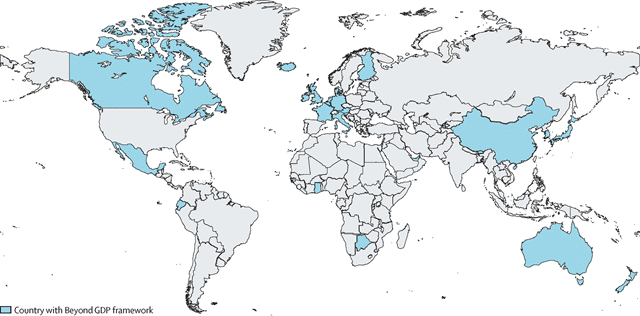
Source: Jansen et al. (2024)